
Short answer
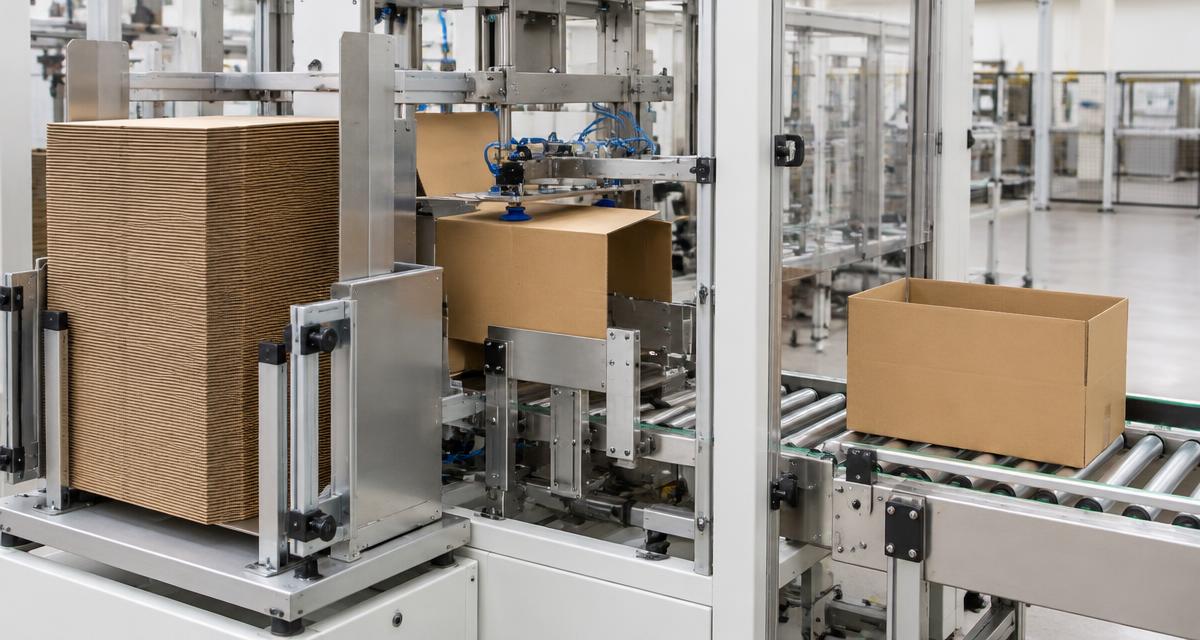
A box that works perfectly when erected by hand may not run reliably through an automated case erector. Consistent dimensions, accurate score lines, suitable board and a well-controlled manufacturer’s joint all affect whether the case opens, squares and seals correctly.
Automating case erection can improve output and reduce repetitive manual work, but it also places greater demands on the corrugated case. A person can compensate for a slightly tight fold or an awkward joint. A machine will normally repeat the same action and expose the same problem every time.
That is why packaging for an automated line should be specified around the machine and packing process, not simply copied from the dimensions printed on an existing box.
Why do boxes fail on a case erector?
Most problems are not caused by one dramatic fault. They are usually the result of small variations that become important at production speed.
Common symptoms include cases failing to open, flaps catching, boxes forming out of square or stoppages at the sealing stage.
Potential causes include:
- Panel dimensions or slots falling outside the tolerance the machine can accept
- Score lines that are too stiff, too soft or positioned inconsistently
- A manufacturer’s joint that is bulky, uneven or poorly aligned
- Warped or bowed blanks that do not feed consistently
- Board or flute combinations that do not suit the forming action
- Changes in moisture, storage or pallet condition affecting how the blanks behave
The case erector needs to be part of the specification
Before a new box is produced, the packaging supplier should understand the make and model of the case erector, the box style, the closing method and the normal running speed.
It is also useful to know exactly where an existing case is failing.
A standard 0201 case may look straightforward, but the relationship between its panels, slots, scores and manufacturer’s joint is what allows it to open squarely.
Matching only the nominal internal dimensions does not confirm that two cases will behave identically on the same machine.
What information should you provide?
Providing the following information gives the packaging manufacturer a much stronger starting point:
- The case erector manufacturer and model
- An approved box drawing or complete current specification, where available
- Several flat and erected samples from a successful production batch
- The product weight and the way it is loaded into the case
- Whether the base is closed using tape or hot-melt adhesive
- Typical line speed and details of recurring jams or stoppages
- Board grade, flute and relevant strength data such as ECT where specified
- Storage conditions and how long flat cases remain in stock before use
Why is one sample rarely enough?
One box can provide useful measurements, but it cannot show the normal variation across a production batch.
Reviewing a selection of flat cases helps identify whether the dimensions, scores, manufacturer’s joint and board condition are consistent.
Where a case already runs successfully, a batch of representative samples provides a much stronger benchmark than one previously erected box.
If the original specification is available, it should be reviewed alongside the physical samples rather than replaced by them.
Test the box on the actual line
A sample can confirm the basic size, fit and construction, but a production-line trial remains the best way to assess machine performance.
The trial quantity should be large enough to expose repeatability issues and should be run at a realistic speed using the normal tape or adhesive settings.
Results should be recorded clearly. If a case fails, note where it stopped, whether the same fault repeated and what adjustment was required.
This gives the packaging manufacturer useful evidence for any design or production change.
Do not assess the box in isolation
Reliable machine performance is only one requirement.
The finished pack still needs to protect the product, stack safely and survive storage and transport. Board grade should therefore be selected using the complete application, including:
- Product weight
- Pallet pattern
- Stack height
- Storage conditions
- Humidity
- Transportation method
- Length of the journey
Over-specifying the board will not automatically solve a machine issue. In some circumstances, a heavier or stiffer material can make folding more difficult.
The objective is a consistent case with the right construction and strength for both the equipment and the supply chain.
Bespoke cases for automated packing lines
Barton Jones Packaging manufactures made-to-measure corrugated cases at our Letchworth site.
We can review existing boxes, approved specifications and machine requirements before producing samples or a controlled trial run.
If your current cases are causing stoppages, send us the machine details, box specification, product weight and a representative selection of successful and unsuccessful samples.
We can assess the complete requirement rather than changing the board grade without understanding the cause.
Related guide: How to change packaging supplier without disrupting supply.
Frequently asked questions
- Can any cardboard box run through a case erector?
- No. The style and size must fall within the machine’s operating range, while the dimensions, scores, manufacturer’s joint and board need to be sufficiently consistent for reliable feeding and forming.
- Why does a box work by hand but fail on the machine?
- An operator can flex, square or reposition a case while erecting it. Automated equipment follows a fixed sequence, so small dimensional or construction variations can cause repeated problems.
- Should we trial boxes before changing packaging supplier?
- Yes. A controlled line trial helps confirm that the proposed case runs reliably and protects the product before the full requirement is transferred.
Having problems with boxes on your packing line?
Send us your current box specification, machine details and representative samples. Our team can review the complete requirement and recommend the next step.
Request a Bespoke Packaging QuoteExplore Bespoke PackagingRelated pages
Subscribe to our blog
One email a month with our latest packaging guides, compliance updates and sector notes. No sales pitches, and you can unsubscribe any time.