
Short answer
Most corrugated boxes use a glued manufacturer’s joint because it is clean, efficient and suitable for a wide range of applications. Stitching is normally considered where the box is very large, the contents are heavy or the joint will face unusually high strain. The best option depends on the complete pack, not the joint alone.
The manufacturer’s joint is where the two ends of a corrugated blank are connected to create a case.
On an everyday transit box it is easy to overlook, but on a large or heavy-duty pack it can become one of the areas most likely to fail.
Both gluing and stitching are established manufacturing methods. Choosing between them starts with the product weight, box size, board grade, handling method and the conditions the pack will experience.
What is a glued cardboard box?
A glued case uses adhesive to secure the manufacturer’s joint.
It produces a neat, flat join without metal fasteners and is the standard choice for many regular slotted cases and printed boxes.
For suitable applications, gluing is fast, consistent and economical. The flat joint is also useful where boxes are packed by hand or run through automated equipment, provided the complete case specification suits the machinery.
When is a glued joint normally suitable?
A glued manufacturer’s joint is commonly used for:
- General transit and ecommerce cases
- Light and medium-weight products
- Printed boxes where a clean external appearance matters
- Regular production runs with consistent handling conditions
- Cases intended for compatible automated packing equipment
What is a stitched cardboard box?
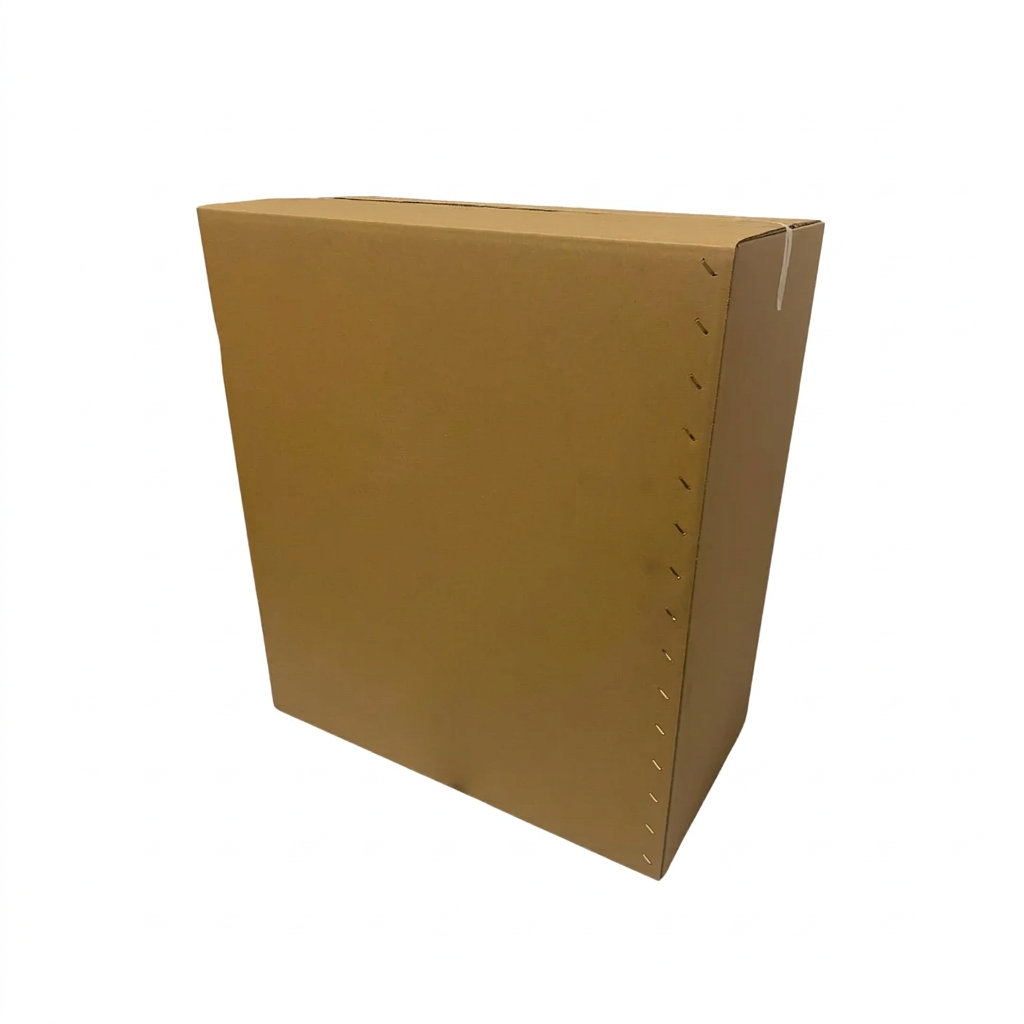
A stitched case uses metal wire fasteners through the manufacturer’s joint. This creates a mechanical connection rather than relying solely on adhesive.
Stitching is generally used selectively for demanding industrial or heavy-duty requirements.
The visible stitches are functional rather than decorative. They may be appropriate where a very large case places greater leverage on the joint, where dense contents create high loads or where the board construction makes a mechanical joint preferable.
When should stitching be considered?
Stitched construction may be appropriate for:
- Large-format or oversized corrugated cases
- Heavy engineering parts, machinery and dense components
- Double-wall or triple-wall packs under high joint strain
- Pallet boxes, sleeves and export cases
- Applications where a glued joint has split or peeled in service
- Low-volume specialist boxes where strength matters more than appearance
Does stitching automatically make a box stronger?
Not by itself.
The performance of a box depends on the board grade, flute direction, dimensions, style, internal support, closure and how the load is handled.
A stitched joint cannot compensate for weak board, excessive empty space or a poorly supported product.
Equally, specifying triple wall and stitching for every heavy item can add cost and make the pack harder to use.
A well-designed heavy-duty double-wall case may outperform a poorly designed thicker box. The construction should address the actual failure risk rather than simply use the heaviest materials available. See double wall vs triple wall boxes for more on board choice.
What else affects the decision?
Product contact: The position of the metal fasteners must be considered carefully.
Stitching may not be suitable where a product could rub directly against the joint or where exposed metal is unacceptable. An internal liner, fitting or alternative construction may be needed.
Storage and moisture: Humidity and storage conditions can change how corrugated board and adhesives perform.
The full environment should be discussed where cases are stored for long periods, exposed to temperature changes or shipped internationally.
Packing and opening: Consider how the box will be erected, loaded, closed and opened.
A joint that is strong in transit still needs to work safely and efficiently for the people handling the pack. Our guide on how to package large and awkward products covers this in more detail.
Recycling: Corrugated packaging is widely recyclable.
Where metal stitching is used, businesses should follow the guidance of their waste contractor, particularly for large industrial quantities or site-specific recycling systems.
Start with the failure you need to prevent
If an existing box is failing, identify exactly what happens.
A joint splitting is different from a base opening, a corner bursting or a box crushing in the stack. Each problem can point towards a different change in board, box style, joint, closure or internal protection.
Photographs, failed samples and details of the product journey are particularly useful.
They allow the packaging manufacturer to recommend a targeted improvement instead of increasing every part of the specification.
Heavy-duty boxes manufactured in Hertfordshire
Barton Jones Packaging manufactures glued and stitched corrugated boxes at our Letchworth site.
We produce made-to-measure double-wall and triple-wall cases, pallet boxes and large-format packaging, including low-volume and short-run requirements. Find out more about our packaging services.
Send us the product dimensions, approximate weight, quantity and details of how the pack will be stored and transported.
If you have a failed box, include photographs or a physical sample. We will recommend whether the joint, board or complete pack design needs to change.
Frequently asked questions
- Are stitched boxes stronger than glued boxes?
- Stitching can provide a robust mechanical joint for heavy-duty applications, but overall box strength still depends on the board, dimensions, style, closure and load. It is not automatically the best option for every product.
- Can double-wall and triple-wall boxes be stitched?
- Yes. Stitching can be used on suitable double-wall and triple-wall constructions, particularly for large cases, pallet boxes and demanding industrial applications.
- Can stitched boxes be manufactured in small quantities?
- Yes. Barton Jones can manufacture specialist heavy-duty and large-format cases in low volumes where the design and material are suitable.
Does your current heavy-duty box keep failing?
Send us the product dimensions, weight, quantity and photographs of the existing packaging. We can review whether the joint, board grade or complete box design needs to change.
Discuss Heavy-Duty PackagingExplore Heavy-Duty BoxesRelated pages
Subscribe to our blog
One email a month with our latest packaging guides, compliance updates and sector notes. No sales pitches, and you can unsubscribe any time.