
Short answer
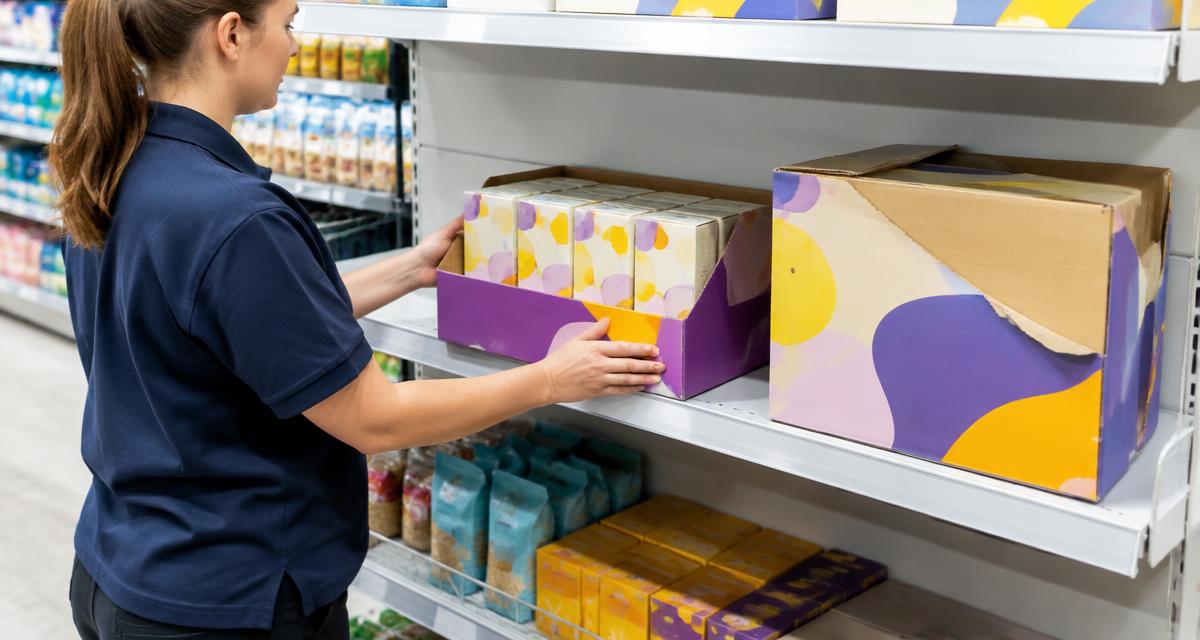
Shelf-ready packaging is a secondary corrugated pack designed to protect products during transport and then move quickly onto a retail shelf with minimal unpacking.
A successful design needs to be easy to identify, open, place on the shelf, shop from and dispose of. It must also remain strong enough to survive packing, palletisation, storage and delivery before the opening section is removed.
What is shelf-ready packaging?
Shelf-ready packaging, sometimes called retail-ready packaging, combines a transit case with an in-store display format.
Instead of removing every product individually from a standard outer box, the retail team opens or removes part of the case and places the remaining tray directly onto the shelf.
Common formats include:
- Trays with removable lids
- Cases with tear-away upper sections
- Printed display trays
- Wraparound cases
- Die-cut packs with perforated openings
- Cases designed around a specific shelf footprint
The correct format depends on the product, retailer, shelf dimensions, packing process and distribution journey.
The five requirements of effective shelf-ready packaging
The corrugated packaging industry commonly describes successful shelf-ready packaging through five practical requirements.
Easy to identify. Warehouse and retail teams should be able to identify the product, size and variant without opening the case.
Product descriptions, barcodes, colour coding and handling information should be positioned where they remain visible during storage and replenishment.
Easy to open. The pack should open cleanly without excessive force or specialist tools.
Perforations, tear strips and removable sections need to be strong enough to survive distribution but controlled enough to open neatly in store.
Easy to place on the shelf. The opened pack should move onto the shelf in as few actions as possible.
Products should remain upright and contained while the case is handled. The finished tray must also fit the intended shelf depth and width.
Easy to shop from. The front of the opened pack should not hide important product information or make individual items difficult to remove.
Products should remain visible, presented neatly and supported as the number inside the tray reduces.
Easy to flatten and recycle. Once empty, the corrugated pack should be straightforward for retail teams to flatten and place into the correct recycling stream.
Unnecessary mixed materials can make disposal more difficult.
Start with the retailer’s requirements
Shelf-ready packaging should not be designed from a generic template alone.
Retailers may have requirements covering:
- Outer dimensions
- Shelf footprint
- Product quantity per case
- Maximum case weight
- Opening method
- Perforation position
- Barcode visibility
- Printed product information
- Tray height after opening
- Pallet configuration
- Material and recyclability
- Sample and trial approval
Obtain the retailer’s current packaging requirements before finalising the design.
A previous pack or an example supplied by the retailer can be helpful, but it should be supported by the latest specification wherever possible.
The box still has to survive transit
The opening feature is only useful if the case reaches the store intact.
Perforations and tear-away sections remove some material from the box and can affect its strength. Their position needs to be considered alongside:
- Product weight
- Number of products in each case
- Pallet stack height
- Pallet overhang
- Stretch wrapping or strapping
- Chilled or humid storage
- Manual and automated handling
- Distance and method of transport
The board grade should be selected around the complete packed and palletised application.
Using heavier board is not always the answer. The structural design, perforation pattern and way the product supports the case all affect performance.
Opening performance matters
A shelf-ready case can fail in two opposite ways.
If the perforations are too weak, the case may split during packing, palletisation or delivery.
If they are too strong, retail teams may struggle to open the pack cleanly. This can leave torn edges, damaged print or a tray that looks untidy on the shelf.
The opening method should therefore be tested using production-representative board and the intended packed product.
The people conducting the trial should follow the same opening method expected in store.
Design around the product
The products inside the case need to remain stable during transport and after the upper section is removed.
Consider:
- Whether products are rigid or flexible
- Whether they can support weight from above
- Whether bottles or packs could fall forward
- How easily the customer can remove one item
- Whether the remaining products stay upright
- Whether the tray exposes enough of the branding
- How the case is filled and closed
- Whether the products are packed by hand or machine
A shelf-ready pack should not create a faster replenishment process at the expense of increased transit damage.
If the case will be filled or closed on automated equipment, our guide to boxes for automated case erectors explains what the machine needs from the case design.
Print and identification
Shelf-ready packaging performs both a logistical and presentational role.
The outer case may need to carry:
- Product and variant information
- Barcodes
- Batch or traceability details
- Handling instructions
- Opening instructions
- Brand colours and logos
- Shelf-facing promotional print
Print positions must be considered in both the closed and opened states.
Important information should not disappear with the removable section unless that is intentional.
Artwork should be reviewed against the approved structural drawing before printing plates or production tooling are ordered. Our guide to printed cardboard boxes, artwork and print methods covers this in more detail.
Food and chilled applications
For food, meat and chilled products, the corrugated outer may also experience cold and humid conditions.
Moisture can reduce corrugated board stiffness and stacking performance. The board specification, pallet pattern and storage conditions must therefore be considered when developing the pack.
The corrugated case is normally secondary or tertiary packaging rather than the material directly touching the food. Any direct-food-contact requirement must be identified and assessed separately. See our food and meat outer packaging page for more on chilled and food applications.
Barton Jones Packaging stores and distributes packaging from BRCGS Storage and Distribution certificated premises and can supply FSC-certified board under licence C214479.
Sample and trial before production
A physical sample allows the product fit, opening method and shelf presentation to be reviewed before a complete production run is approved.
A useful trial should assess the pack in both forms:
- Closed, packed and palletised for distribution
- Opened and displayed in its intended retail position
Check that:
- The packed case remains square and stable
- Perforations survive handling and palletisation
- The removable section opens cleanly
- The tray fits the intended shelf
- Products remain upright and accessible
- Barcodes and important print remain visible
- The empty pack can be flattened easily
Any agreed changes should be added to the controlled drawing and specification before production. Our guide to packaging samples, line trials and production approval explains what each stage proves.
Shelf-ready packaging manufactured in Hertfordshire
Barton Jones Packaging designs and manufactures bespoke corrugated packaging at our Letchworth site.
We can manufacture printed outers, die-cut trays, wraparound formats and cases with removable or perforated sections.
Send us the product dimensions, quantity per case, packed weight, print requirements and the retailer’s current specification.
Where appropriate, we can produce a physical sample for product, line and shelf trials before the full production run is approved. Our packaging services cover design, sampling and production support.
Frequently asked questions
- Is shelf-ready packaging the same as retail-ready packaging?
- The terms are often used interchangeably. Both normally describe secondary packaging that protects products in transit and can then be opened and placed directly into the retail environment.
- Does shelf-ready packaging have to be printed?
- Not always, but clear product identification, opening instructions and barcode positioning are often important. Printed branding can also improve shelf presentation.
- Can shelf-ready packaging run through automated equipment?
- Yes, if the design, dimensions, board and closure method are compatible with the equipment. The proposed case should be trialled on the intended packing line before full approval.
- Does every retailer use the same shelf-ready packaging rules?
- No. Retailer requirements can differ, so the current specification should be obtained before the design is finalised.
- Can Barton Jones produce a sample before manufacturing?
- Yes. Where appropriate, we can produce a physical sample so the product fit, opening method and shelf presentation can be reviewed before production.
Sources
Developing packaging for a retail customer?
Send us the product dimensions, quantity per case, packed weight and the retailer’s current packaging requirements. We can help develop and sample a shelf-ready format for your application.
Discuss Shelf-Ready PackagingExplore Food and Retail PackagingRelated pages
Subscribe to our blog
One email a month with our latest packaging guides, compliance updates and sector notes. No sales pitches, and you can unsubscribe any time.